
The following is… long. If you’d like to download a PDF version, you can do so here.
If you’d like an ePub version, you can get it here.
I never sat with someone dead before.
It’s not as awful as I imagined. It’s also worse.
My dad lies in his bed at the nursing home. My mom traces fingertips across his forehead. She moves a stray hair. Homa offers comfort. I sit trying to take this all in.
I stare at his slightly opened mouth. I look at the texture of his skin. He somehow looks younger than he did the day before. I know I project. I know our minds play funny games, but he looks serene.
I’m not.
I hate this place. I hate the two-and-a-half years we’ve been here. I hate the lingering smell of urine in the air. I hate the daily vigil my mom kept. I hate who my dad had to become to be here. I hate the visits my daughters and I made. I hate how I struggled week after week to sit with him as he struggled to form words. I hate how his decay and that of those around him caused me such unease.
It’s just life, my older brother once told me. I know, I replied.
That somehow made it harder and I hate that.
We tell soft jokes to comfort ourselves. The nurses tell me that my dad died moments after they showered him. It was 11:05 in the morning. They were getting him ready to have a Valentine’s lunch with my mom.
The next day we inform the funeral director that my siblings are coming to town. They want to see the body. He says he’ll have to clean it for viewing. We tell him they won’t need to do much. He showered just before dying. My dad was fastidious that way, I say. I try to smile when I do.
I used to sit on his bathroom counter as a kid about the age my children are now and watch as he clipped his nails. First he did his and then he did mine.
Nine months later we have our rhythm. I wake the girls and make them breakfast. Homa brings them to school. I stare in the mirror at my thinning hair. Homa alternates between heat and ice on her thrown out back.
I wonder if my perpetually cranky right knee might need replacing. Homa makes trips to her factory in New York City. I bring Yasna to Saturday morning ballet. Homa brings Zomorōd to Monday afternoon ballet.
After my dad died, a friend’s dad died, and then another friend’s dad died, and then yet another. Homa’s mom had a stroke. After a few fretful days in the hospital, she turned out okay. I call my mom throughout the week. I visit her at least twice. We try to do Saturday sleepovers. She’s 89 years old.
Most days, Homa heads to the Orchard House to work in the quiet there.1 If the weather’s right, I’ll stop by for a few hours to clear brush for the fruit trees I want to get into the ground next Spring. I then head home to write.
At least that’s what I try to do. In theory, I’m working on an essay collection. In practice, I dawdle, humbled by the slog of it all.
Everything takes longer than I imagined. I don’t know as much about the subjects I write about as I thought I knew. More important, I don’t know as much about myself as I thought I did.
Case in point: There’s a road here in southern Rhode Island I drive most every day. I drive it on the way to school. I drive it on the way to my mom’s. I drive it to the beach. I drive it to the girls’ doctor. I drive it to the grocery store.
One day while driving it, I had an idea. How would this trip to my mom’s go if I traveled by horse? What if I traveled by horse because we no longer had cars? What if we no longer had cars because we no longer had energy to fuel them? It was a silly thought. I have lots of them. But I poked at it. I like a good rabbit hole.
I’m now some twelve thousand words into an essay about this road. It goes from the colonization of the Americas to artificial intelligence and energy policy and back again. I try to weave anecdotes and reflections on why I drive it almost every day of the week. But I don’t know as much as I wish I knew.
My knowledge of English settlers is middle school thin. My knowledge of Rhode Island’s founding even thinner. My understanding of the Narragansett, the Wampanoag and the sunksqua Weetamoo that tried to accommodate the colonists almost non-existent. So I read books and learn.
My understanding of myself — my motivations, privations, hopes, sorrows, dreams, and my place in this world with this family— is neither deep nor interesting, not in a way I can articulate anyway.
I can’t read myself. There’s no book of me to turn to. Instead, it’s just thoughts while driving along this road; reflections on my interactions with my kids; prompts from Homa when we draw swords and do battle; and occasional epiphanies with my therapist when I bring it all up.
I learned a new word recently. Gallimaufry. It’s a confused jumble or medley of things.
They talk about sleep hygiene in the wellness community. The terminology amuses me. One’s sleep should be clean. Pristine. Not mine. Mine’s filthy.
I go through frequent bouts of insomnia. I lay awake through the dark hours of early morning. I tell myself I should write down the thoughts coursing through my head. I don’t because I think I’ll remember them when I eventually get out of bed. I never really do, or they’re not quite as poignant as they were in the silence when I was awake.
If it’s not insomnia, it’s Yasna. For months now she comes to our room some time between 12:30 and 1:30am. She climbs over Homa and lays down between us. She then starts to twirl. Up and down and all around she’ll helicopter trying to get comfortable.
I inevitably get a foot in the face. I inevitably get up to go to the bathroom. I inevitably return to the bed to find Homa lying somewhere in the middle, Yasna perpendicular to her and maybe the tiniest ledge left on the side for me to sleep on.
Most nights, I end up going back to Yasna’s bed with my phone in hand and scroll. I don’t know what I’m looking for save an answer to a question I can’t quite articulate. I’ll know it when I find it, I tell myself.
This night is different. Yasna’s voice pulls me out of my sleep. I open an eye and listen. It’s dark out.
“Baba?” her voice comes quiet down the hallway. I open my other eye. “Babaaaaaa?!?!” she’s urgent now.
I slouch on the edge of my bed. I take a drink of water. I check the time. Not bad, I think, she slept deep into the night. It’s 5am. I walk to the girls’ room.
Yasna is crying. She sits on her heals on top of her bed. “Why did you take so long? I called you forever.”
It’s five in the morning. I’m groggy. I sit on the edge of her bed. I tell her I was asleep.
“But why?” she wails. “I’ve been calling you.”
“I can’t hear you when I’m asleep,” is all I can say. “Can you hear me when you’re asleep?”
“I called you forever!” She yells at me. Her nose runs. Her chest heaves up and down. “I called you for a really long time.”
I know she’s five; I know she feels betrayed; I know those meant to protect her did not come when called; but I haven’t slept through a night in months and I’m itching to push back. Earlier in the year, I’d wake and think through my dad’s eulogy. Now it’s Yasna, night after night after night. I have no patience to go back and forth on this.
I look at Zomorōd. Her eyes are closed. “Zomorōd doesn’t hear you even though you’re yelling,” I tell Yasna. “I didn’t hear you either. I was sleeping.”
“But why didn’t you come?” She doesn’t understand me and I can’t explain myself to her.
Sometimes I wonder if screaming will get a point across – BECAUSE I WAS GODDAMN ASLEEP – but I don’t want to wake Zomorōd. I don’t want to wake Homa. I don’t want to wake Homa’s parents who have been with us since the summer.
“Yasna,” I grind. “Why didn’t you come to our room?”
“Because my legs are asleep,” she sobs.
“Just like your legs are asleep,” I say, “my whole body was asleep and I couldn’t come.”
This seems to make some sense to her. She looks at me waiting for more.
“Yasna,” I continue, “I was sleeping. I was in my dreams. I had animals, people, and creatures all talking. When you called me, your words had to get into my body, go through the world of my dreams, find me, tap me on the shoulder, say, ‘Hey, Yasna is calling for you,’ wake me up, get me out of bed, and bring me here so I could be with you.”
“I don’t want you here,” she sniffles and covers her head with a blanket.
“You don’t want me here?”
“Go away,” she says. “I don’t want you here.”
I sigh. I walk to our living room. It’s dark out. It’s 5am. It’s mid-November. I pull out my phone and scroll. I don’t find anything interesting.
“Baba,” I hear. I get up and brace myself for another round. When I get to her doorway, she tells me she’s awake now and won’t be going back to sleep. I ask if she wants to come with me.
“Yes,” she says.
The two of us lie down on the living room couch. Yasna nestles into my side. We pull a blanket over ourselves. “And now we get all snugly,” she tells me.
Two hours later, when Zomorōd sits at the table eating her breakfast, she looks at me and asks, “What were you guys arguing about?”
“Zomorōd,” I say. “I thought you were asleep.”
Zomorōd looks at me. “I was totally awake. I just kept my eyes closed.”
“See, Baba,” Yasna smiles. “People do hear me when they’re dreaming.”
If, some twenty-five hundred years ago, I was a Greek fisherman working the Gulf of Corinth, I might join a trail of pilgrims passing by and walk the final miles from my village to the southern slope of Mt. Parnassus. There, I’d read the command that’s rolled through history, chiseled on the Temple of Apollo: Know Thyself.
Back then, I’d sacrifice my goat and ready myself to meet the Oracle. She’d riddle my future, the temple priests would help make sense of her words, and that, more or less, would be that.
Our world doesn’t allow for oracles anymore. At least mine doesn’t. Instead, I head to my therapist. I ask her what we’re doing here. I ask what I’m supposed to know about myself and why. She turns my questions back on me and asks what I want to get out of our sessions together.
It’s December as I write. Flat gray days give way to early nights. We buy the girls a few new items to keep them warm. Zomorōd keeps outgrowing her pants and sweaters. Yasna seems to appreciate the hand-me-downs.
I’m a stone’s throw from my 54th birthday and ponder what that means. I wonder how who I am at 54 is different from who I was at 44 or 34 or 24. The questions differ but it strikes me odd that there are still so many.
How, after some fifty years, do I still not know myself? Or, if I rethink the question smarter, what, after some fifty years, am I trying to find within myself? What’s with the nagging introspection?
The Dictionary of Obscure Sorrows made up a word for this. It’s German, of course, because that’s one of the finest languages we have to mash disparate words together to make something new.
Altshmerz
n. a sense of weariness with the same old problems that you’ve always had, the same boring issues and anxieties you’ve been gnawing on for decades, which makes you want to spit them out and dig up some fresher pain you might have buried in your mental backyard.German alt, old + Schmerz, pain. Pronounced “alt-shmerts.”
When is enough, enough, I ask my therapist. How deep do I need to go? And what do we do about the fact that who I am now isn’t who I was five years ago or twenty-five years ago, and probably won’t be who I’ll be five years from now or twenty-five years from now?
Besides, I’m tired.
I wouldn’t go to therapy, I sulk, if I didn’t have a wife or kids or a father who just died or a mother who needs my support. Instead, I’d tread in my stew.
But I do have a wife. I do have kids. I do have a father who just died. I do have a mother who relies on me. So that’s not the way it can be.
The day after my dad died we went to the funeral home to see his body. My mom apologized for weeping. I asked her not to.
“You had 65 years with him,” I said. “Of course it hurts.”
Without thinking about it, I then said something along the lines of, “And I had 53, and Peter 49, Tina 56 and Stephen 58. We had over two hundred eighty years of experience with him.”
Age, I’ve decided, is more than the linear time we spend on earth. It includes the collective experience we generate. It’s a patchwork of interwoven experiences we share with acquaintances, friends, and intimates. They are moments trivial. They are moments profound.
I counted a few thousand years of experience in the room where I offered my dad’s eulogy. Outside that room are thousands more.
As I write this, Zomorōd is 2,759 days old and Yasna is 2,234. The thing that I have done more than anything else since they were born is to put them to sleep. I have done this well over 2,000 times, probably about 90% of each of their lives.
Bedtime is simultaneously the sweetest and the most annoying thing in my life. Before they settle in, they will toss and turn, they will get out of bed, they will find something that they absolutely need to bring back into bed. This could be a stuffed animal, it could be a bead, it could be a piece of string. Whatever it is, it is absolutely essential to them.
Yasna calls it fiddle faddle. It’s both a noun and a verb. “Can I fiddle faddle?” she’ll ask. Or, “Can I get my fiddle faddle?”
I used to lambast them for this. I raised my voice, I demanded that they do this or that to fall asleep. I relaxed over the last year or so and now let them fiddle faddle – as annoying as it might be – so that they get comfortable enough to fall asleep. We all fidget, after all. We fuss about before doing whatever it is we’re meant to do.
The two share a room. They have single beds but decided soon after they got them that instead of separating them with a night table, they wanted them pushed together. Night after night I lie between them, read them a story, and stare at the ceiling fan as they eventually fall asleep, Yasna on my right shoulder, Zomorōd on my left.
Yasna snuggles in tight. She invented a word for this too. She calls this a “nipper”. It’s a tight embrace. It’s an embrace that doesn’t let go. Zomerōd lies close but does not like to be held.
There are two places I do my deepest thinking: the first is when I drive alone on southern Rhode Island’s back roads, the other is in these moments when I lie here and the girls drift to sleep.
I lay silent. I barely move. They try to strike up conversation. I answer their initial questions and then tell them that we can continue at breakfast the following morning.
They, of course, whine. They say that they won’t remember tomorrow what they want to talk about today. I say that then it must not be so important and we should all go to sleep. And then they moan and groan and protest, but I lay there quiet.
And soon they nestle in — my right arm under Yasna and my left arm under Zomorōd. Eventually, I hear the heavy breathing of each. After thinking for a while, I extricate myself from underneath them and get out. Or, more often than Homa likes, fall asleep and wake about midnight.
This sometimes goes sideways. Tonight, for instance, Yasna won’t get into bed.
She says it’s itchy. I say it wasn’t itchy yesterday. She says it’s itchy today. I ask if it’s the sheets. She says it not the sheets but instead the whole bed. I ask how she can say the whole bed is itchy if she hasn’t even tried to get into it.
“It’s itchy,” she declares, and that’s that. She kneels on the floor and buries her face between her legs. Her next words come muffled.
“I’m going to sleep in your bed,” she announces.
“Not an option,” I say.
“Then I’m sleeping on the bathroom floor,” she tells me.
“Also not an option,” I say.
Yasna protests and Zomorōd, now curious, sits up to watch. I now have two girls who won’t go to sleep which means I’ll have two girls in the morning who won’t wake up and it’ll be all stress and strain to get them to school on time.
Yasna weeps. Her bed’s itchy, she doesn’t want to get into it, and no one will listen to her. She’s belligerent and I fight an irresistible urge to match her with a scream. She wails. I fight my desire to yank her off the ground, throw her into the bed, and wipe my hands of it.
Something shifts, though. I kneel. “Come,” I say. I try to be tender because somewhere under the frustration I know these big feelings. I know not being able to explain them. I know how it hurts. “Come with me.”
We stand together in the playroom. The girls’ dollhouse stands four feet tall against a wall. Their day’s drawings litter the floor. I clear space on a rug and lay down blankets. I get her a pillow. I tuck her in. I ask what was itchy and she tells me it was her comforter. I get her some tissues so she can blow her nose.
I then bring the comforter from her room and make a show of putting a new duvet cover on it. I put it over her.
“How’s that?” I ask.
“Good,” she tells me. “Not itchy.”
I lie on a couch. Yasna lies on the rug. She tells me she wants to nipper. I tell her I’m not getting on the floor but we can nipper in her bed.
“You know,” I say to her as we walk back down the hall, “sometimes life is itchy and you just have to deal with it. There might not be someone there to take the itch away.”
“I have people,” she tells me.
“Well,” I try, “sometimes you just have to deal with things being itchy.”
Yasna sits on her bed. She thinks for a moment. She looks at me.
“Sometimes my snow pants are itchy,” she eventually says, “and I deal with it.”
I went for a walk in the woods on a cloudy day. I went to find meaning. I went to breathe anxieties away. I brought my camera to see if I might capture what I saw.
I went for a walk in the woods on a snowy day. The ground was soft. My footprints were loud. They creaked enough that I startled a bevy of deer and watched them bound away.
I stared at oak and hickory. I took pictures of rocks. I planned to write something meaningful when I got home.
But my dad died.
He didn’t die with me. He died in his nursing home. He died while I was taking a shower thinking about my walk in the snowy woods and how I hoped to draw some meaning out of that.
He died while I lathered my scalp and washed my arms. I found out when I stepped out, dried myself off and checked my phone. I had a three-word text message from my mom: “Your father died.”
In my mother’s telling, she found out while driving to see my father for a Valentine’s Day lunch. The nursing home called her. She couldn’t figure out the connection between her phone and her hearing aids so pulled into a parking lot. She could hear the nurses now.
“I never wailed like that,” she tells me. Years of sorrow erupted. She wailed in a parking lot next door to the nursing home because she couldn’t figure out how to connect her phone to her hearing aids and now her husband lay dead next door.
This is what she tells me as we sit with his body at the nursing home. We sit with him for hours.
When I taught graduate school, I sometimes lectured about how we know things simply by living in an information society. An example I gave was a game called “Last Man”. In it, players compete to be the last person to find out who won the Super Bowl. The game never lasts very long. Humans share things.
Despite that and beyond formal and informal education, I don’t really know how we know the things we know. Knowledge about the exterior world and our interior selves sometimes just presents itself. Sometimes.
I once thought a great idea, a life-changing epiphany, or a spiritual revelation would come to me if I could just introspect alone unbothered. I pictured these things like flowers ready to bloom. Never happened.
Either it doesn’t work like that, I didn’t tend to them properly, or my emotional soil is too fallow to get me there. Maybe I’m just not introspective enough. I get distracted by curiosities like why the alphabet goes A to Z and not the other way around.
Head down that rabbit hole and you discover there are 26! impossibly large ways to order the alphabet.2 We know of no actual reason that we need to start with A, B, and C and end with X, Y, and Z. We could cluster the consonants together, we could cluster the vowels together, we could do an alphabet by the frequency of letters across the language. We do it the way we do because that’s the way we’ve always done it.
That’s what those who study the matter say and I’m comfortable with that. I’m comfortable with a lot of life’s ephemera.
But turn inward. Why do two young girls who can’t get somewhere on time fluster me so? Why do I silently scream when explaining yet another email that confuses my mother for the third time?
That’s what I find when I look inward. I don’t find great insights. That’s not what sprouts within me. Instead, a hodgepodge of logistical discomforts makes things itchy.
I’m reading The Captive Mind, a collection of essays about the rise of fascism and totalitarianism in Eastern Europe after World War II. The essays trace the mutability of human actions and thinking in the face of external pressures. Czeslaw Milosz begins the book by quoting “an old Jew of Galicia”:
When someone is honestly 55% right, that’s very good and there’s no use wrangling. And if someone is 60% right, it’s wonderful, it’s great luck, and let him thank God. But what’s to be said about 75% right? Wise people say this is suspicious. Well, and what about 100% right? Whoever says he’s 100% right is a fanatic, a thug, and the worst kind of rascal.
What if we turn this idea inward? What percent of ourselves are we comfortable knowing or not knowing?
I think through whom I might be. There are easy knowns among the unknowns. I’m the father of two young kids. I’m the son of a needy mother. I’m the husband of a striving wife. I am the brother of equally flawed siblings. I’m a sounding board for my sister-in-law. I’m the guy who gets breakfast and lunch ready for my in-laws’ granddaughters.
I’m fifty-plus-years-old and I’m content in my discontent.
I don’t say that fatalistically. I don’t mean to imply that I give up. I just know that after years of struggle, of addiction, of anxiety, of confusion, of trying to understand my place in the world, I landed on my feet and when I look around, I’m not troubled by what’s become of me.
It may not be what I expected. It may not be what I hoped for, but I’m more or less content even though I may not appear as such.
Over the summer, I stood in the parking lot of the beach I’ve gone to since I was born. A woman who’s known me since then just turned 80. She holds my face in her hands.
“Michael,” she says, “I want you to be happy.”
I look at her eyes and I look at the lines in her cheeks. I don’t really know what to say.
“Are you happy?” she asked me.
“I think so,” I say. “Things are pretty good.”
She says she read an essay I wrote and if there’s anything she can to do to help, she’s there for me.
Her hands are on my cheeks and we stare quietly eye to eye. I find this uncomfortable.
“We’re always here for you,” she says.
This is great, I think, and wonder whether I can ask if she babysits.
“Thank you,” I finally say. “But really, things are okay.”
My dad taught me to ski. He held me between his legs as we glided down a near flat slope in Waterville Valley, NH. Over and over we went. To me, it was heaven. As a parent now, I understand the tedium he probably felt going up and down a beginner slope when a larger mountain beckoned.
We eventually graduated to Valley Run. This was an intermediate slope that you rode an actual chairlift up. Up we went. And down again, me between his legs.
Until… until on one run he let go. He let go and gave me a gentle push ahead as he slowed himself down. I felt myself gliding further and further from him. I was doing it. I was skiing. I was free!
And that, in part, was his parenting style. First he’d guide you. Then he’d set you free.
My parents’ 60th anniversary would have been in late May. On the Thursday it rolls around, I call my mom and ask if Homa and I can bring her out.
“Do you want to make me cry?” she asks.
“Yes,” I say. “It’s the only way we get through this.”
I come from an emotional family that did not share emotions — at least not the hard ones, the sorrows, the disappointments. Anger, we flashed at one another, but hurt and pain were hidden.
At least for me. I grew up presenting a calm veneer, pretending that things were okay no matter the turbulence underneath.
Now, commercials make me teary.
I’m of the epistemological opinion that you don’t really know something until you can explain it to a five-year-old.
This isn’t to say they don’t humble you with their questions. They do.
“You never know what you don’t know until you have kids asking you questions about everything all the time,” a mom of one of Yasna’s classmates says to me.
Some I get. More I stumble upon.
Difference between a frog and a toad? No problem. Where do butterflies go at night? I know that one. Why will the sun explode when it runs out of fuel? Getting harder. How come you always take the trash out? Ask your mother.
At dinner, Yasna asks, “Is one less than infinity a number?”
“No, it’s still infinity,” I say.
“How is that?” she asks. “How can it still be infinity?”
“Well, infinity is more of a concept than a number. It’s just everything. And even if you take one away from everything, you still basically have everything.”
Yasna doesn’t like this answer. “You just took one away from everything,” she says. “So you don’t have everything.”
I don’t like my answer either, know I can’t explain it better, and change the subject. “Did you know that once upon a time there wasn’t a zero? They had to create zero.”
Zomorōd and Yasna look at me confused.
“How can there be no zero?” they ask.
“There just wasn’t, so a guy in India invented it.”
“Does that mean they never had nothing?”
“Well, they had nothing. They just couldn’t add or subtract it.”
“I think there’s always something,” Yasna says, and Zomorōd agrees. “There’s always something even if you think you have nothing.”
There’s always something. How long will it be until they understand how right they are?
A few days later Zomorōd bonks her head and a few days after that she still complains about headaches. I drive her to the doctor. She’s seven years old and likes to knit. She knits in the back seat.
Zomorōd: Baba?
Me: Yes, bubs.
Zomorōd: Jaspar says his dad’s balls hang down to his knees.
Me: 😳
Zomorōd: And he says he has to rearrange them all the time because it’s uncomfortable.
Me: I can’t wait to ask Jasper’s dad about it.
Zomorōd: Nooo!!!
Me: Why not?
Zomorōd: Because that would be so inappropriate. It’s disgusting.
Me: When did you learn the word “inappropriate”?
My mom keeps a list of tasks she needs me to do when I visit. She begins reciting them as I enter the door and continues as I take off my shoes. If I’m lucky, she finishes as I hang my jacket.
“And how are you?” I’ll ask.
“I don’t know yet,” she’ll reply.
She keeps a folder of bills she’s unclear about, email printouts that don’t make sense to her, and handwritten notes about other things she has trouble with. I’ll bring her lawn furniture in. I’ll explain that I don’t know much more about Medicare than she does, but that I can schedule an appointment with the community center where a woman with incredible patience will walk us through various options.
I explain that her car registration is set, I took care of it last week, and if she looks in the folder she’ll see I wrote just that on a sticky note attached to the notice she received saying that she needs to get new registration stickers.
Yes, I tell her, I’ll follow up with her car insurance. And, yes, if she really wants to comparison shop with other insurers because she spoke with a friend in another state who pays a lower premium, we can do that too.
This email’s been taken care of, that email is spam, so too this text message and yes, I understand how frustrating it is to wait on hold to make a doctor’s appointment. No, I don’t know the password to get into her doctor’s portal, but I can reset it so that we can.
Zomorōd sits on my lap in our living room. We listen to a story called Granny Snowstorm and watch the sun splash pastels of yellows, purples, and pinks across the sky.
Zomorōd asks me to cradle her.
“With both hands,” she says. “And can you rock me?”
“Do you miss being small?”
“Yeah.” She nuzzles into me.
Zomorōd turned seven this summer and is over four-and-a-half feet tall. She’s 70 pounds.
When I bring her to the doctor for her annual checkup and they measure all this, they show me a chart where she’s well beyond the 100th percentile in height and somewhere in the 80th for weight. At school, she towers over kids. When we’re out and about, and she’s with eight and nine-year-olds, she often towers over them too.
So it’s been since she first learned to stand and could tower.
She carries a weight about herself. It’s a shackle of self-imposed responsibilities. She’s wants to know the rules for everything. She wants to follow those rules. She’s confused when others don’t follow rules. She asks why I drive over the line in the road if the rule is that we’re not supposed to drive over lines in the road. She asks why people rob and steal if robbing and stealing is illegal. She took it upon herself to be her free-spirited, younger sister’s keeper. This frustrates her but she does it anyway.
At school, we talk with her teacher about lightening her; of letting her be free; of figuring out how she can shed this instinctual responsibility and be a seven-year-old kid. When she laughs, or sings, or dances, she levitates. It’s a beautiful thing to see.
Now, though, she wants to be little.
We lay in bed at night as we’ve done some 2,000-plus times before. And like those 2,000-plus times before, I can feel her mind roar as she processes this day, and the day before, and the days before that.
She won’t fall asleep until she’s exhausted herself. Even then, she fights it.
“Baba,” she says tonight after 30 or 40 minutes of silence where I’m thinking of all this. “When we drove to Canada, I felt sick in the car. We didn’t stop even though I told you.”
I’m quiet as I think of how she carries this memory from a drive that happened over a year before.
“That was a long time ago,” I say.
“Maybe you didn’t hear me.” She falls silent again save for the whir of her thoughts.
She aspires to be.
To be what, I don’t know. She doesn’t know. She doesn’t have the words yet.
But she mourns, like her mom, what’s left behind in the becoming.
She misses being little.
My father died in February. In June, we gathered friends to celebrate his life. In between, I lay awake most nights trying to make sense of who he was, what our relationship was, and, by extension, who I am and what my relationship with my daughters is and will be.
I’d wake, think my thoughts, tap notes on my phone, and try to get back to sleep. I often ended up lost, unable to identify anything significant. Instead, small moments came to me.
I remembered what my father smelled like when he came home from a weekend night out with my mom and checked in on me as I pretended to sleep.
It was the muskiness of the Old Spice cologne he wore and the sweetness of the Dubonnet he drank. It was the smell of safety and security. It was the smell of him returning home.
I remembered as a kid watching my dad shimmy in his underwear when he exercised in the morning.
I remembered that this made me laugh.
I remembered it made me laugh because when he shimmied in his underwear, it looked a lot like Steve Martin’s Wild and Crazy Guy routine and that made me laugh too.
I remembered how he taught me how to hit a tennis ball, read, do math, and swing a golf club.
When we planned his Life Celebration, my mother asked if I could say something lighthearted about my dad.
“Of course,” I reply.
“He wasn’t really lighthearted,” she murmurs.
This is true. Many things are true. My dad had lighthearted moments but he wasn’t lighthearted by nature.
A family friend pulled me aside after his funeral. He disagreed with everyone who said my dad was kind. Stern, he thought, was a better word. Wonderful, but stern.
And, again, this is true. My father was wonderfully kind. He did many wonderfully kind things for many that we knew. He was also fantastically stern, especially if you were his child and he didn’t think you put the effort in to reach various potentials.
He was kind. He was stern. He was joyful. He was stoic. He contained, as Walt Whitman reminds us, multitudes.
A few weeks before we gathered to celebrate my father, I learned that my daughters think I’m grumpy. I walked in on a conversation Homa was having with them.
“I like making grumpy Baba laugh,” I hear Yasna say.
“I’m not grumpy!” I call from across the room. “I’m sparkles, bubbles, and sunshine.”
No, they insist, I’m grumpy. To two young girls that I bark at in the morning to hurry, or in the evening to go to sleep, or at dinner to stop wandering away from the table, I’m grumpy.
To them, at this moment in their lives, they have a grumpy father.
My dad was forty-one when I was born. He was the first in his family to go to college; he entered the Air Force and spent time in Korea; he went to graduate school; he married my mother; he had two kids; he moved from New York City to Massachusetts to start a company; he brought it public; his life was textured and deep; and then he had me.
He was in his sixties when I graduated from college. By his mid-seventies, I perceived the beginnings of his cognitive decline. By his eighties, he was an entirely different person than the dad I remember growing up with. By his nineties, he was a shell of the man I remember. But, memory isn’t clarity. It’s warped by whatever impressionable self I was when I originally remembered.
Late at night, I wonder whether I consider him stern in the way my daughters think me grumpy. I question my narratives.
These are the notes I jot on my phone. How did I know my dad and how is that colored by the age in my life that I knew him? How do my daughters know their dad? How will they know me?
These memories of things past mix happiness and a nostalgic longing, both for the father I knew and the person I was at the various stages of our lives when I knew him. Nostalgia somewhat captures the feeling.
The Portuguese word saudade does it one better. It includes the idea that this simultaneous happiness and longing is for something lost forever.
These are some of the things I thought since his death. It’s a jumbled medley of things.
Homa’s mom and I take Zomorōd to the mall to get her winter clothes. Last year’s no longer fit and the weather is turning quick. Leaves fall to the ground. Frost covers our windshield in the morning.
“Baba,” Zomorōd asks, “if I find something I like, can I buy it for myself?”
Of course she can. Over the last year, Zomorōd collected a few coins here, a dollar bill or two there, and saved it all in a pouch. We count it out on the dining table. Zomorōd has $20.
“I really want to get myself something,” she says.
She sees a locket in one store. She holds it in her hands. It’s close to what she wants, she tells me, but she wants one that’s a bit bigger. She wants one that can hold treasure. I tell her there are other stores we can explore in this mall. We can poke around and see if we find what she wants.
Meantime, we buy a pair of jeans, a sweater and a few long sleeve shirts.
We find her a jacket at Macy’s and next to the girls’ clothes section is a wall of dolls. She likes them. She explains the various princesses in this package and that. She’s infatuated by some of the accessories they have. This isn’t what she’ll buy though.
Let’s keep looking, I tell her, and we head back into the mall. We mull through a few stores. My phone rings. It’s Homa.
Yasna had a bonk. She wiped out running through the house and has a bloody nose. I’m on the phone with Homa and Zomorōd asks what’s happening.
“Yasna had a bonk and got a bloody nose,” I tell her. “She’ll be okay.”
Zomorōd looks concerned. “Baba,” she tells me. “I want to go back to the red store.”
“The red store?”
“The one with the Christmas decorations, with the big red balls hanging from the ceiling.”
“Macy’s?” I ask.
“Yes, Macy’s. There’s something there I want to get for Yasna.”
Back we go to Macy’s. Zomorōd leads the way. Homa’s mom and I follow. Past the perfume and makeup counters, up the escalator, through the women’s section, and right back to the girls’ toy section.
Zomorōd holds a Moana doll in her hands. Moana is a character from one of the girls’ favorite movies. “Do I have enough money?” she asks.
I hold the price tag toward her. “How much is it?”
“$19.99,” she says.
“How much do you have?”
Zomorōd smiles. Zomorōd glows. Her eyes squinch tight as her cheeks grow big with a smile. She wraps her arms around the Moana box.
Zomorōd had $20 to spend on herself.
Zomorōd spent $20 on a gift for her sister.
In November 1915, a thirty-six-year-old Albert Einstein lived alone in wartime Berlin. His wife had left him and taken their two sons to Switzerland. Accounts from this time describe Einstein as frail and fatigued. A friend described his house a mess, said he and others needed to help him with everyday chores, and that Einstein barely ate or slept unless prompted.
Despite all this, Einstein gave a series of lectures at the Prussian Academy of Sciences. Over the course of four weeks, he unveiled his general theory of relativity. He expanded on his theory in 1916 and proposed the existence of gravitational waves – tiny ripples in the fabric of space-time that spread through the universe at the speed of light. They form when colossal objects like black holes or collapsing stars move, crash or violently accelerate.
Researchers confirmed Einstein’s prediction one hundred years later when they detected these waves. They did so with the Laser Interferometer Gravitational-Wave Observatory (LIGO), an incredibly sensitive instrument built to capture waves generated over a billion light years away.
The waves are whispers by the time they reach us; so small they were nothing but conjecture until ten years ago. The LIGO measures them at about 1/10,000th the width of a proton.
My mother’s father was a ten-year-old living in eastern Germany when Einstein gave his lectures. He was the illegitimate son of an older Jewish man and a young Catholic woman.
He did not know that his mother was his mother. Instead, he knew what he was told, and grew up believing his mother was his older sister. He did not discover that his mother was his mother until she died and her two daughters approached him with her will. In it, they told him, their mother revealed that he was not her brother but, instead, their brother and the three siblings would now equally inherit the family apartment.
My mother was eight years old when allied troops stormed Normandy. My grandfather was a forty-year-old prisoner in a Nazi labor camp. He helped dig the trenches that slowed their progress.
He escaped the prison camp and walked from the coast of France back to his family in eastern Germany. My mother says she didn’t recognize him when he arrived at their door. He carried about a hundred pounds on his frame. For the rest of his life, my mother tells me, he attacked food as if he would never eat again.
My mother describes her mother at this time as rough, strict, and dour. My mother resented her mother for that. It wasn’t until she was much older that she understood what her mother actually went through during the war. She raised two kids alone in a bombed out city. Her husband was a Nazi prisoner. She had to tell neighbors that her husband fought alongside their husbands. She had to pretend she was proud.
When the war ended, my mother’s family lived under Russian occupation in East Germany. My grandfather smuggled people to West Germany. He smuggled himself out when he was tipped off that the Russians planned to arrest him. My mother, her mother, and her brother soon followed undercover. They reunited with my grandfather in Nuremberg.
There, my mother says, she had a miserable teenage life. She felt entirely alien in Nuremberg. Her father shut down conversations about his experience. Her father had no patience for her teenage flirtations. Her father tied an emotional tourniquet around his past and in doing so cut off his present.
Whoever I am now, I unconsciously pass the quiet familiar of this history from my mother and her parents and their parents before them to my daughters. They come from my dad’s parents too, and their experience sleeping on pool tables in Manhattan during the Depression. Homa and her family have similar stories as Zoroastrians in Iran, of living through the Iranian Revolution, of living through the Iran-Iraq war, of living as immigrants in America.
People crash. Our lives are colossal. To us, anyway.
Our histories can be quiet or loud. Either way, they reverberate. They echo through time, captured by whatever manifests as our internal LIGO. They form psychological and emotional waves that either diminish in intensity generation to generation, or redouble pathologically with new moments colossal as we crash through the world.
I think of these imperceptible waves as I lay tight with my girls and they drift off to sleep. I think of them as I snap in the morning when I can’t get the girls out the door. I think of them when I wonder what drives me; what affects me; what paralyzes me; what tunes me to react to things as I do. I think of them when I wonder what is learned and what is innate.
This, I think, is what people talk about when they talk about generational trauma. But if generational trauma can pass along, then so too generational hope and generational euphoria and we must learn how to better pass those positive traits along too. The remnants of each may travel at different cadences, velocities, and densities, but they all, collectively, reach us.
And that, to paraphrase Whitman, is another way we contain multitudes.
“Cock-a-doodle-doo!” Yasna yells from the bathroom. I’m in the kitchen making dinner.
“Cock-a-doodle-doo!” she yells again.
I walk down the hall. “What’s going on?” I ask. She looks up at me from the toilet.
“I’m done pooping,” she says.
“But what’s the cock-a-doodle-doo for?” I ask.
“It means I’m done pooping.”
Of course it does.
Yasna’s been many things in her six years: A vampire, a squirrel, a cat. She embodies these personas fully. On the winding branches of life, she goes far out on those limbs and explores. Annoying? Yes. But also awesome to see.
We all do it, too. We have our personas. We cultivate and curate narratives about ourselves. Few are lucky enough, or bold enough, to yell cock-a-doodle-doo.
A few nights later, I’m again in the kitchen. I’m again making dinner.
“Baba,” Yasna yells. She’s in the bathroom. “Baba!”
I walk down the hall.
“What’s going on?” I ask. She looks up at me from the toilet.
“I’m done pooping,” she says.
“What happened to cock-a-doodle-doo?” I ask.
“The rooster’s sick,” she explains. “Today, you get a plain alarm.”
Monsters, my daughters inform me, are afraid of the light. This makes it important to make sure the night light in their room, along with the one in the hall, functions properly. It’s a matter of survival.
The three of us lie in bed.
“Baba,” Zomorōd asks, “what’s gravity?” Her head rests on my left shoulder. Yasna’s rests on my right.
“Gravity is what keeps you grounded,” I try. “It’s what keeps your feet on the ground. Without it, we’d float away.”
The girls go quiet. They fall asleep. I stare at the still fan on their ceiling. I try to stay grounded. The mishmash of life tumbles through my head. I think of my dad and the different relationships I had with him. I think of my mom and the guilty weight I carry into her home each week knowing I would or could or should do more for her if not for the rest of my life that precludes doing more for her. I think of Homa and how I’m not all that I could be for her. I think of the girls pinning down my arms and the lives they will lead. I think of a magazine job I took in my twenties. I think of our family tech company that went belly up in my thirties. I think of the times I made this choice rather than that choice. I think of whether any of those choices were the right choice.
I think how I recently learned that I misinterpreted Robert Frost’s “The Road Not Taken”.
“Two roads diverged in a yellow wood,” the poem famously begins.
And here is how it famously ends:
Two roads diverged in a wood, and I,
I took the one less traveled by,
And that has made all the difference.
I always thought this an ode to the iconoclast who travels their merry way off the beaten path. I thought it a clichéd affirmation of non-conformity, an American slogan of sorts.
Cock your head, though, and linger in the middle lines. They don’t celebrate. They lament. They reveal that the narrator hopes to travel one road now and the other road later. He understands that life being life, he’ll never get to do both.
Oh, I marked the first for another day!
Yet knowing how way leads on to way
I doubted if I should ever come back.
This is the soudade of choice. Do this and you can’t do that. Choose this and you can’t choose that. The option is lost forever and that has made all the difference.
Decades before Frost wrote his poem, Søren Kierkegaard fiddled with the conundrum. He’s kind of funny.
Listen:
Marry, and you will regret it. Do not marry, and you will also regret it. Marry or do not marry, you will regret it either way. Whether you marry or you do not marry, you will regret it either way. Laugh at the stupidities of the world, and you will regret it; weep over them, and you will also regret it. Laugh at the stupidities of the world or weep over them, you will regret it either way. Whether you laugh at the stupidities of the world or you weep over them, you will regret it either way. Trust a girl, and you will regret it. Do not trust her, and you will also regret it. Trust a girl or do not trust her, you will regret it either way. Whether you trust a girl or do not trust her, you will regret it either way. Hang yourself, and you will regret it. Do not hang yourself, and you will also regret it. Hang yourself or do not hang yourself, you will regret it either way. Whether you hang yourself or do not hang yourself, you will regret it either way. This, gentlemen, is the quintessence of all the wisdom of life.
Do, or don’t do, Yoda echoes. We mourn the loss of what could have been.
Some people have the maturity to accept the choices they make in life. They reflect on them with calm.
Not me, but some people.
As I write this, Zomorōd is seven and Yasna is six. Their questions come in waves.
What’s the scariest thing you’ve ever done? they ask. We’re eating dinner. They both look at me, waiting, expecting.
I think of potential answers and make mental flowcharts to game plan follow-up questions they may have. I pick at the bewildering depression of my teenage years and the crushing anxiety of my addiction years. Too soon. I’ll save those for when they’re older.
“Your mother and I are in therapy,” I’m tempted to say, but don’t think they’ll follow the weight of that so I settle on a more distant story.
I lean forward. I look at Zomorōd. I look at Yasna.
“You really want to know?”
Their eyes widen. Yes, yes, they do!
“I almost lost my leg,” I tell them.
I tell them about the time I snowboarded above the tree line after a good-sized winter storm. I tell them how wall-to-wall sunshine shown above and fresh powder trailed behind me as I carved large turns in the snow. I tell them how I looked across the valley beyond the mountain ridge. I tell them that life was good and peaceful and beautiful.
I tell them how I then banked right and turned my head to look out at the other side of the mountain. I tell them how instead of looking out at another valley, I looked instead at the only tree in hundreds of yards in any direction. I tell them how that tree was no further from me than the end of the table is now. I tell them how I hit that tree at thirty or forty miles per hour and almost lost my leg.
What I don’t tell them is the year-long recovery; the violent dreams of crashing into – or being crushed by – things; the heavy doses of oxycodone and muscle relaxant that fueled those dreams, or the miserable withdrawal from them.
But I do tell them that this is why Baba’s knee can now tell when it might rain. I tell them that it might even need to be replaced now that the cartilage is worn and arthritis is settling in.
I walk into my mom’s house. She sits at the dining table, a pile of papers in front of her. It’s various bills and documents that she tries to organize so I can take care of them.
“How are you?” I ask.
Her eyes well up. “Really sad,” she says. “I miss my husband. I miss who my husband was.”
I hug her. “I miss my father, too,” I say.
“I’m sorry I’m like this,” she says.
“It’s perfectly okay for you to be.”
“I’m lonely,” she blows her nose.
My daughters adopted a playground theology. It’s part animist, part deist, includes a heaven somewhere beyond the stars above, and is full of fairies and forest spirits. Yasna explores it during her Memas’ birthday. Memas is Homa’s mom.
Yasna holds a candle in her hand. A bit of cake lingers on its end. She licks it off. “Are you going to make a wish?” I ask.
Yasna says she did make a wish. But she’s coy. She’s not going to tell us what it is.
She pauses for a moment. And then she says, “If God answers my wish, He exists. If He doesn’t answer my wish, He doesn’t exist.” It’s a very simple binary – and a very real binary – that I didn’t know that she was thinking about.
I’m tempted to tell her about others who wrestled with such questions.
Descartes conceived a perfect being. Maybe a god who answers wishes is a perfect being, I could say.
Theologians used modal logic throughout the years to prove God exists, but I don’t need to go there. Yasna has her finger on the pulse of what is symbolically and spiritually important to her at this very moment.
If God grants me my wish, He exists.
If he does not grant my wish, He does not exist.
It is simple. It is clean.
Zomorōd’s questions are less about faith. Existence is a given. She wants to know what a supreme being actually is.
She shares discussions she has with classmates. Some, she tells me, say God is a god over other gods. Others say God is something in everything. They’ve come to agreement, she explains, that Santa isn’t God but can see everything like God. And, finally, they wonder what would happen if you died and discovered God was a giant chicken.
“How giant are we talking about?” I ask.
Zomorōd points to the six-foot tall mango tree growing in our living room. “About like that.”
“That would be silly,” I say.
“But can you imagine?”
I do imagine.
I imagine as I stand on the side of the road. It’s Halloween evening. We blew out a tire while driving home. Homa’s mom came to pick her and the girls up, and now I wait in the dark for roadside assistance. It’s cold but my bee costume keeps me warm. It’s a black and yellow striped onesie that I wear over long underwear.
The blowout saved us from a Yasna meltdown. She wanted to eat her Halloween candy. We wouldn’t let her. It was too late. We don’t eat sugar right before bed, we told her.
“Why do we even trick or treat if we can’t eat the candy,” she wails from the back seat of the car.
It’s an insightful if utilitarian question: why do anything if we can’t savor a reward?
I’m not particularly quick on my feet. Arguments come and go. I feel my way through them in their aftermath and think of things I should have said when they flared.
Like now, on the side of the road, waiting for a tow truck to fix a blown out tire. The wind blows. The cold gets under my bee costume.
It’s here I think I could have told Yasna about the Bhagavad Gita. She likes stories, after all, so why not the Hindu epic on duty and responsibility?
“You have a right to perform your prescribed duty,” Krishna tells Arjuna early in the narrative, “but you are not entitled to the fruits of action.”
Translate this for a 21st century little girl and it might sound like so: “You did the hard work of getting Halloween candy but that doesn’t mean you can now eat it.”
Some stories don’t land right for kids.
The tow truck comes. I try to impress upon the mechanic that I wear a bee suit because my kids were with me. He grunts his disinterest as he works to get a stuck lug nut off the tire. I think of caring for my mom and my children. I think how we’re reflections of duties and obligations. What those duties and obligations are differ. Some are chosen, others are foisted upon us. That is our dharma: to children, to parents, to family, to friends, to community.
I endure meltdowns because the joy on the flip side fills unsteady gaps I forget I have. Like Yasna, I have an economics. I supply an input: endurance. I receive an output: contentment.
Sometimes. It’s itchy.
I sometimes think of myself as an experiment: what happens when you take a man who lived thirty years in New York City and place him in the woods along the Rhode Island-Connecticut border? What happens if you add two young kids, a wife, a dad with Alzheimer’s, a mom with growing infirmities, and in-laws who live in a room off the kitchen five months of the year? What happens if you take a man who worked at the moment-to-moment speed of online media and is now a homebody trying to grow trees?
I happen. I write words. Words like these.
Along the way, I decided to slow down, or move slower than contemporary life would otherwise have us. I decided to understand seasons and change. I decided to follow the lifespan of trees. Yet, there’s a tension here. As I get older, life pushes the other way. Deliberation does not obviate obligation. Change is sometimes quick.
My mother is 89 years old. How many more years I have with her, I do not know. My daughters grow. I see pictures from just a few years ago and they were tiny. Now, they are large. When Homa and I fight, she tells me she worries that my journey moves too slow and that one day she’ll just give up. She will no longer fight for what she believes in and wants. It’s not that she won’t love me, she says. It’ll just be different. And we will have left something of our selves behind.
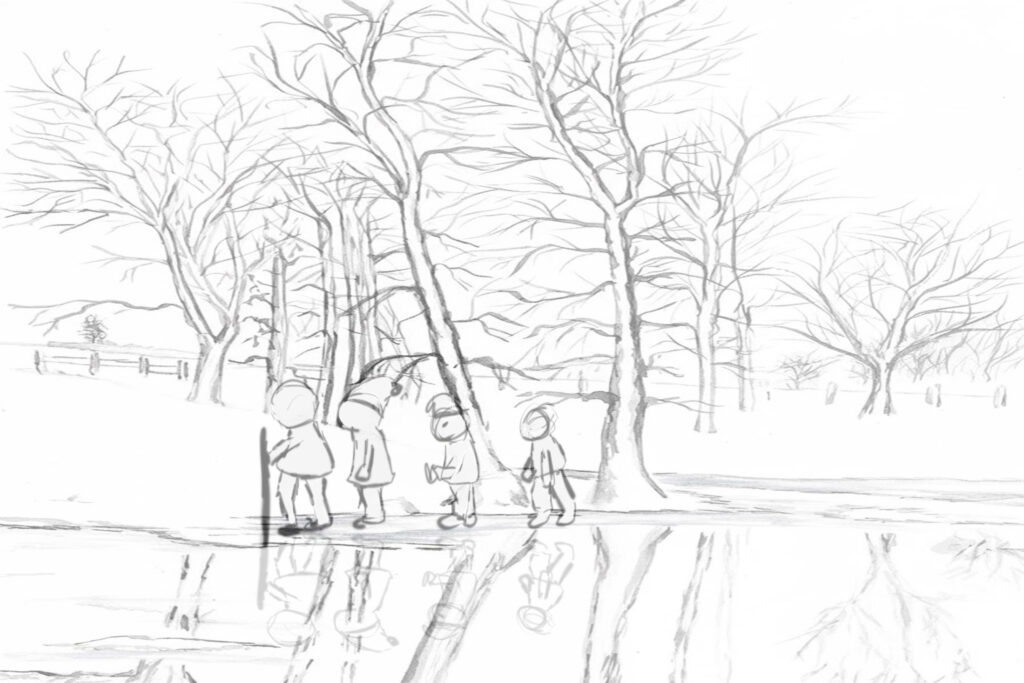
Meantime, it’s winter here in Rhode Island. There’s snow on the ground and the eighty-acre pond we live on is frozen. We walk across the ice. I go first and Homa and the girls follow. I jab at the ice with a five-foot long, eighteen-pound steel wedge to make sure it’s thick enough that we don’t fall through.
I think these thoughts as I drive the back roads of southern Rhode Island. I listen to quiet music. It’s layers of sounds I pull over myself as solace to my solitude.
“Baba?” Yasna calls from her bedroom. Again, it’s the middle of the night. Again, Homa is working in New York. Again, I’m tired. Again, I’m up scrolling my phone, thinking I’ll find an answer to a question I can’t yet articulate.
“Everything okay?” I stand in the girls’ doorway. I got here after a single call.
Yasna sits on her bed and fiddles with her fingers. Zomorōd sleeps beside her.
“You made it,” she smiles. She looks down at her hands. She looks back at me.
“Not bad,” she says. “Not bad.”